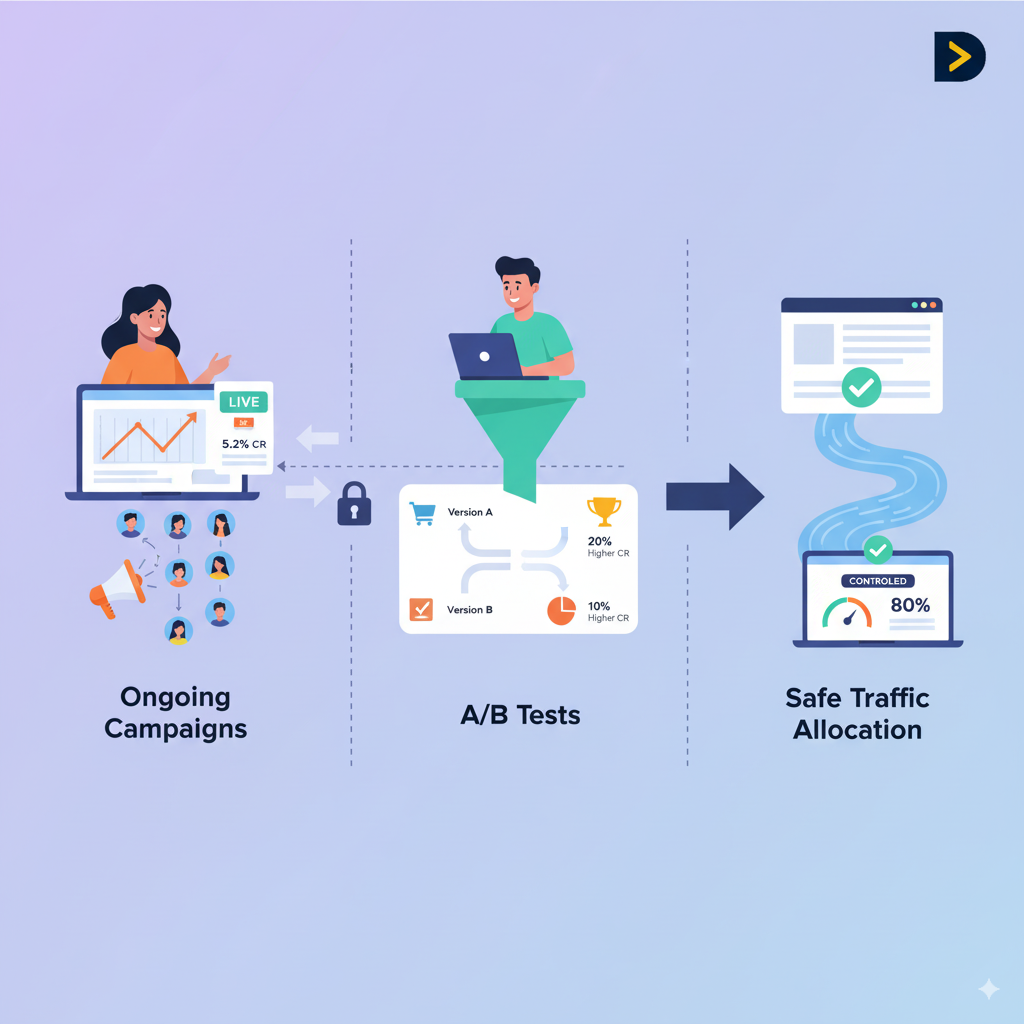
How Do We Ensure Tests Do Not Interfere with Ongoing Campaigns?
Posted on September 25, 2025
Running A/B tests, multivariate tests, or other experiments is essential for improving marketing performance and conversion rates. However, one of the biggest challenges businesses face is ensuring that these tests do not interfere with ongoing campaigns, potentially skewing results or impacting revenue.
In this article, we’ll explore best practices, real-world examples, and actionable strategies to run experiments safely while maintaining the integrity of ongoing marketing campaigns.
Understanding the Risk of Interference
When running multiple campaigns simultaneously, interference can occur in several ways:
Traffic Overlap: If the same audience is exposed to multiple tests or campaigns, results may be contaminated.
Conflicting Messaging: Experiments that change copy, offers, or design might conflict with active campaigns.
Data Pollution: Metrics from ongoing campaigns may get mixed with test data, leading to inaccurate conclusions.
Example: SaaS Landing Page
Imagine a SaaS company running a paid ad campaign for a product launch while also testing two variations of the landing page. If the same audience sees both versions, conversion rates may reflect audience bias rather than true performance differences.
Best Practices to Prevent Test Interference
1. Use Audience Segmentation
Segment traffic to isolate test participants from ongoing campaigns:
Separate audiences by geography, demographics, or behavior
Dedicate a percentage of traffic to experiments while the rest continues with the active campaign
Example: Direct Experiment allows marketers to split traffic intelligently so that only a subset is exposed to a new variation, while the remaining users experience the ongoing campaign.
2. Schedule Tests Strategically
Avoid overlapping critical campaigns with experiments:
Identify high-priority campaigns and avoid running conflicting tests during peak activity
Use staggered testing windows to prevent overlaps
Example: An eCommerce brand schedules holiday sale A/B tests a week before the main Black Friday campaign to avoid interference with high-traffic promotions.
3. Tag Campaign Traffic
Tracking traffic sources helps identify and isolate campaign-specific traffic:
Add UTM parameters to paid ads and email campaigns
Filter test data in analytics platforms to exclude specific campaigns
Ensure conversion metrics are accurately attributed
Example: If a Google Ads campaign is running, Direct Experiment can filter out those clicks to ensure the A/B test measures only organic or direct traffic.
4. Leverage Testing Tools with Smart Traffic Allocation
Modern A/B testing platforms like Direct Experiment offer advanced features to avoid campaign interference:
Randomized traffic distribution to avoid overlap
Traffic throttling for sensitive periods
Real-time monitoring to detect anomalies in data
By using these tools, marketers can safely run multiple experiments without affecting ongoing campaigns.
5. Monitor Metrics and Anomalies Closely
Even with safeguards, monitoring is essential:
Track key performance indicators (KPIs) before, during, and after the test
Look for unexpected drops or spikes in conversions, clicks, or revenue
Pause tests immediately if interference is suspected
Example: If an email marketing campaign’s open rate drops after launching a landing page test, it may indicate that the experiment impacted messaging perception.
6. Document and Communicate Testing Plans
Transparency is key:
Maintain a centralized testing calendar
Share testing plans across teams (marketing, product, UX)
Clearly outline start/end dates, traffic allocation, and campaign interactions
This reduces accidental overlaps and ensures all teams are aligned.
Real-World Case Studies
Netflix: Uses audience segmentation and randomized allocation to run multiple experiments without impacting content recommendations.
Airbnb: Isolates test audiences geographically and temporally to prevent conflicting experiments on promotions or homepage design.
Similarly, Direct Experiment allows marketers to control traffic allocation, isolate tests, and monitor KPIs in real time to ensure ongoing campaigns remain unaffected.
Key Takeaways
Segment audiences to avoid overlapping traffic.
Schedule tests strategically to prevent conflicts with high-priority campaigns.
Tag campaigns and filter traffic to maintain clean data.
Use smart testing tools like Direct Experiment for traffic allocation and monitoring.
Monitor KPIs closely for anomalies.
Document and communicate all tests across teams.
By following these best practices, businesses can maximize learning from experiments without risking ongoing campaign performance. Well-planned testing not only safeguards current campaigns but also accelerates growth through data-driven insights.
FAQ: Running Tests Without Affecting Campaigns
1. How can I prevent A/B tests from interfering with active campaigns?
Use audience segmentation, traffic allocation, and campaign tagging to isolate test traffic. Tools like Direct Experiment make this process automated and precise.
2. Can multiple experiments run simultaneously safely?
Yes, as long as traffic is properly segmented and campaigns are tagged. Randomized traffic allocation and staggered testing windows help prevent overlap.
3. Should I pause ongoing campaigns when testing?
Not necessarily. By isolating test traffic and tagging campaigns, you can continue running ongoing campaigns without interference.
4. What metrics should I monitor during tests?
Track conversions, clicks, revenue, and engagement KPIs. Look for anomalies or unexpected drops that may indicate interference.
5. How does Direct Experiment help prevent interference?
Direct Experiment allows marketers to control traffic allocation, isolate test groups, and monitor KPIs in real time, ensuring experiments do not disrupt ongoing campaigns.