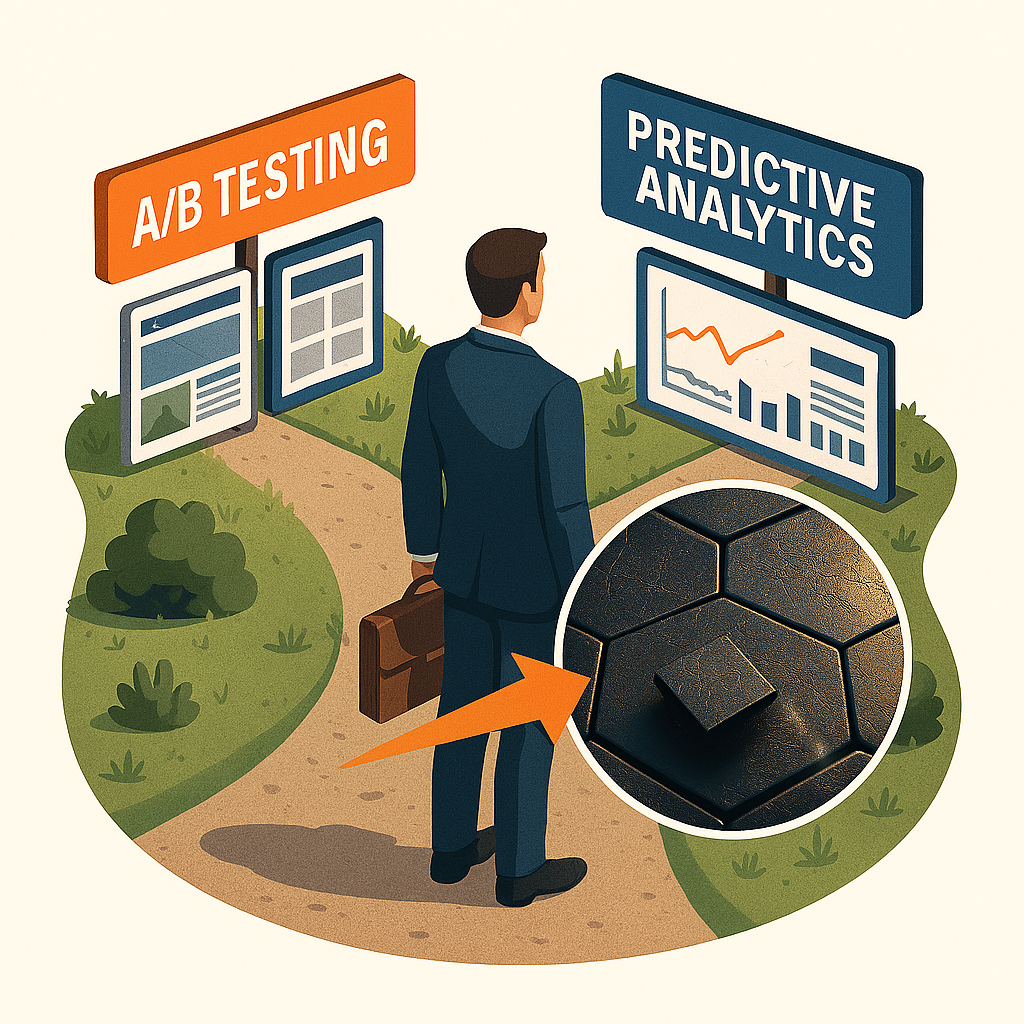
Predictive Analytics vs A/B Testing: Which Drives Better ROI?
Posted on October 2, 2025
Understanding A/B Testing
A/B testing, also known as split testing, is one of the most widely used methods for optimizing marketing campaigns, websites, and product experiences. In this approach, two or more variations of a webpage, ad, or product feature are tested against each other to determine which one performs better. For example, an e-commerce company might test two different product page designs: Version A with a blue “Buy Now” button and Version B with a red one.
The results are measured based on key performance indicators (KPIs) such as conversion rate, click-through rate, or revenue per visitor. If Version B results in a 12% higher conversion rate compared to Version A, the company may adopt Version B across its website.
According to a 2022 report by Invesp, 71% of companies run at least two A/B tests per month, and companies that regularly test are 2X more likely to report significant ROI improvements. However, while effective, A/B testing has limitations—it requires time, enough traffic to generate statistically valid results, and only tests a limited set of scenarios.
Understanding Predictive Analytics
Predictive analytics takes a more advanced approach by using historical data, machine learning models, and statistical algorithms to forecast future outcomes. Instead of simply testing two versions of a page, predictive analytics can analyze large datasets to determine customer behavior patterns and predict how likely a user is to make a purchase, churn, or upgrade.
For example, Netflix uses predictive analytics to recommend shows and movies based on a user’s watch history. This personalized approach has been credited with saving the company over $1 billion annually by reducing customer churn. Similarly, in e-commerce, predictive analytics can identify which customers are most likely to respond to a discount campaign, helping marketers target promotions more effectively.
The predictive analytics market itself is growing rapidly. According to MarketsandMarkets, the global predictive analytics market size is expected to reach $28.1 billion by 2026, growing at a CAGR of 21.7%. Businesses are increasingly realizing that predictive modeling not only saves time but also drives ROI by enabling smarter decision-making.
Key Differences in Approach
The main difference between A/B testing and predictive analytics lies in reactive vs. proactive strategies.
A/B Testing is reactive: it evaluates changes after implementation to see which one performs better. The learning process is iterative and gradual.
Predictive Analytics is proactive: it forecasts outcomes before making changes. It can simulate different scenarios and recommend the best strategy without needing to expose users to underperforming versions.
For instance, if an online retailer wants to improve email open rates, A/B testing might involve sending two subject lines to different groups and waiting for results. Predictive analytics, however, can analyze prior email campaigns, customer demographics, and behavior to predict which subject line is most likely to resonate with each segment—even before sending it out.
ROI Comparison: Which Delivers More?
When it comes to ROI, both methods offer unique advantages depending on the business context.
A/B Testing ROI:
Requires traffic and time for statistically significant results.
ROI is measurable but may take weeks to realize.
Works best for incremental improvements, such as boosting landing page conversions by 5–10%.
Predictive Analytics ROI:
Delivers faster insights and allows hyper-personalization.
Higher upfront investment in tools and data science expertise.
Potential ROI is larger—Forrester reports that organizations using predictive analytics are 2.9 times more likely to achieve revenue growth above industry average.
For example, a SaaS company using A/B testing might increase sign-ups by 8% after testing different pricing page layouts. But the same company using predictive analytics could identify that enterprise users from the financial sector have a 35% higher lifetime value and focus its sales efforts there—yielding a far greater impact on revenue.
When to Use A/B Testing vs. Predictive Analytics
The choice between the two depends largely on company maturity, resources, and objectives.
Choose A/B Testing when:
You want to optimize small, specific elements like button colors, CTA wording, or ad images.
Your business lacks large historical datasets.
You prefer low-cost, straightforward experiments.
Choose Predictive Analytics when:
You have access to big datasets (e.g., customer purchase history, behavioral logs).
Your goal is to forecast outcomes such as churn, demand, or sales trends.
You want to maximize ROI through data-driven personalization.
Many successful organizations combine both. For instance, Amazon relies heavily on predictive analytics to recommend products but still uses A/B testing to refine interface design and marketing copy.
Final Verdict
A/B testing and predictive analytics should not be seen as competitors but as complementary strategies. A/B testing is excellent for quick, tactical improvements, while predictive analytics drives strategic, long-term ROI through foresight and personalization.
Businesses that integrate both approaches tend to outperform their peers. In fact, according to Deloitte, companies that are “insight-driven” and leverage predictive models alongside testing are 23 times more likely to acquire customers and 19 times more likely to be profitable.
In conclusion, if ROI is the ultimate goal, predictive analytics offers the higher ceiling, but A/B testing remains an essential stepping stone—especially for businesses just beginning their data-driven journey.