Should You Focus on Top-of-Funnel or Bottom-of-Funnel Improvements First?
Posted on September 25, 2025
When growing a business, one of the most common dilemmas for marketers, product owners, and growth teams is whether to prioritize top-of-funnel (TOFU) activities like traffic generation or bottom-of-funnel (BOFU) improvements such as conversion rate optimization. Choosing the right focus can drastically impact revenue, growth trajectory, and marketing ROI.
In this article, we’ll break down when to prioritize TOFU vs BOFU, share real-world examples with factual numbers, and provide actionable insights to maximize results.
Understanding the Funnel: TOFU vs BOFU
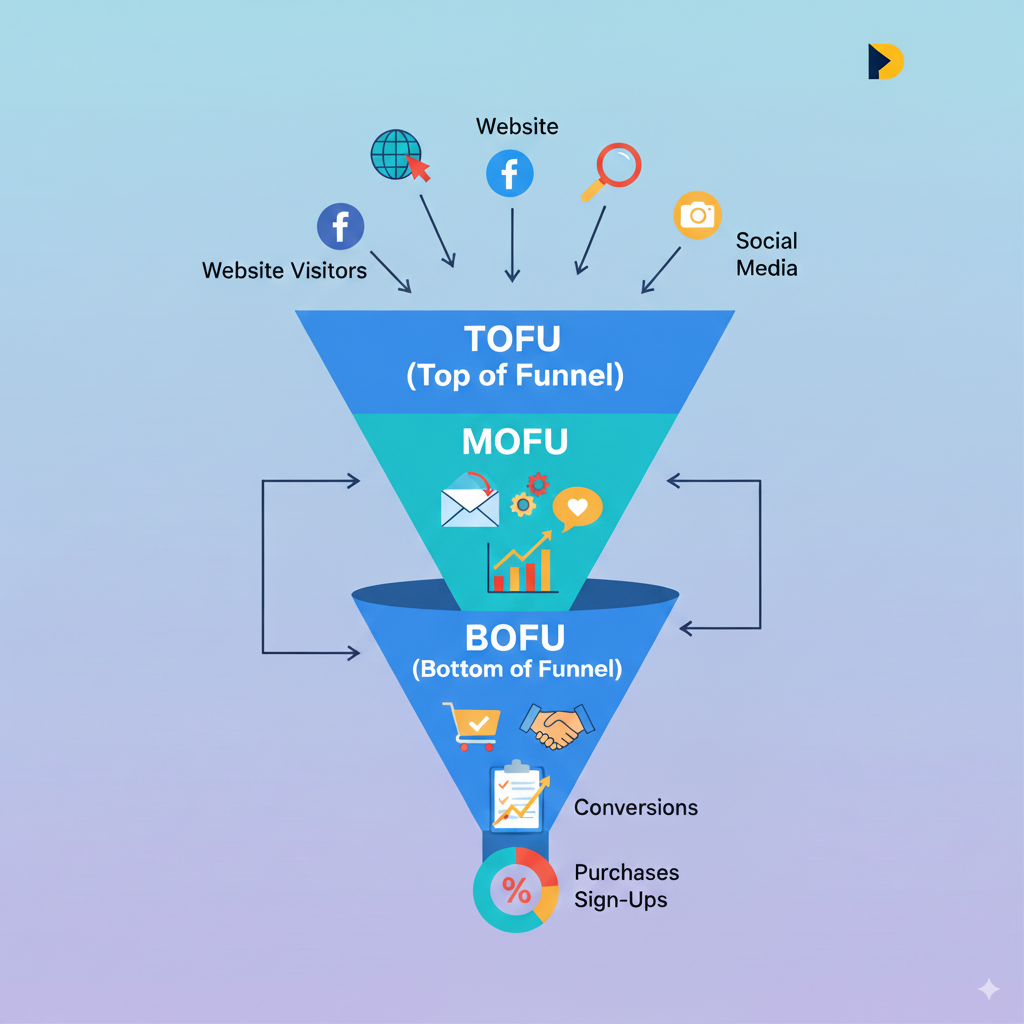
To make an informed decision, it’s important to understand the marketing funnel structure.
Top-of-Funnel (TOFU)
TOFU represents the awareness stage, where your goal is to attract a large number of potential customers. Key activities include:
SEO and organic content
Blog posts targeting high-intent keywords
Paid ads (Google Ads, social media)
YouTube and webinar content
Social media campaigns and community building
Goal: Drive traffic and introduce your brand to new prospects.
Bottom-of-Funnel (BOFU)
BOFU represents the conversion stage. Here, your goal is to convert existing leads into paying customers and maximize lifetime value. Key activities include:
Landing page and checkout optimization
Retargeting campaigns
Email nurturing sequences
Free trials or product demos
Upsell and cross-sell campaigns
Goal: Improve conversion rates and revenue per visitor.
Why TOFU Can Be Your First Priority
If your website or product has low traffic, focusing on BOFU may not yield substantial results. Optimizing a funnel that has only a trickle of leads may lead to negligible gains.
Example: SaaS Startup
Suppose a SaaS company has 500 website visitors per month with a 3% trial sign-up rate:
Visitors: 500
Trials: 15
Paid conversions (20% of trials): 3
Even if the company doubles its conversion rate from 3% to 6%, the outcome is only 6 paying customers per month—hardly scalable.
Now, if the same company invests in TOFU efforts to drive 5,000 visitors per month:
Visitors: 5,000
Trials (3% sign-up): 150
Paid conversions (20%): 30
This results in a 10x increase in paying customers, showing that TOFU efforts can multiply growth before focusing on conversions.
Why BOFU May Yield Faster ROI
Once traffic reaches a substantial volume, improving conversion rates often delivers faster and more predictable ROI than attracting more visitors.
Example: eCommerce Brand
An online store with 100,000 monthly visitors and a 1.5% conversion rate:
Orders: 1,500
Average order value (AOV): $50
Monthly revenue: $75,000
Optimizing the checkout process to achieve a 2.5% conversion rate:
Orders: 2,500
Monthly revenue: $125,000
This shows an immediate $50,000/month increase without spending more on advertising.
Factual Benchmarks and Data
Understanding industry benchmarks can help guide your funnel strategy:
Website conversion rates: 2–5% average across industries (WordStream, 2024)
SaaS free trial-to-paid conversions: 15–25% (Totango, 2023)
Landing page optimization impact: Up to 300% improvement in some industries when tested and optimized using tools like Direct Experiment and HubSpot.
SEO traffic growth: 7–9% monthly growth with consistent content (Ahrefs)
These stats highlight that TOFU improvements compound over time, while BOFU improvements often provide quicker wins.
Deciding Based on Your Funnel Stage
Here’s a practical framework:
Stage 1: Low Traffic (<2,000 monthly visitors)
Priority: TOFU
Focus on awareness and generating leads.
Example: Blogging, SEO for high-intent keywords, and social media campaigns.
Stage 2: Moderate Traffic (2,000–20,000 monthly visitors)
Balanced focus on both TOFU and BOFU.
Conduct small A/B tests on landing pages while scaling traffic.
Stage 3: High Traffic (>20,000 monthly visitors)
Priority: BOFU
Focus on conversion optimization, retargeting, and retention strategies.
Real-World Case Studies
Dropbox: Early growth focused heavily on TOFU through referral programs, growing from 100,000 to 4 million users in 15 months.
Amazon: While TOFU traffic is massive, Amazon’s BOFU optimizations (personalized recommendations, 1-click checkout, Prime memberships) maximize conversions and revenue.
A Balanced Approach: Sequential Optimization
The most successful companies treat TOFU and BOFU as complementary:
TOFU first – generate awareness and build traffic.
BOFU next – optimize conversions to maximize revenue.
Reinvest profits – scale traffic again and repeat.
This creates a growth flywheel: traffic drives conversions → conversions drive revenue → revenue funds more traffic → continuous growth.
Key Takeaways
Early-stage startups → focus on TOFU first to build awareness.
Scaling businesses → focus on BOFU for immediate ROI.
Long-term growth → sequentially optimize both to sustain and multiply results.
Pro Tip: Companies balancing TOFU and BOFU improvements see 30–50% faster revenue growth than those focusing solely on one stage (McKinsey Digital, 2024).
By understanding your funnel, evaluating traffic, and analyzing conversion opportunities, you can decide where to invest your marketing efforts for maximum growth and profitability.