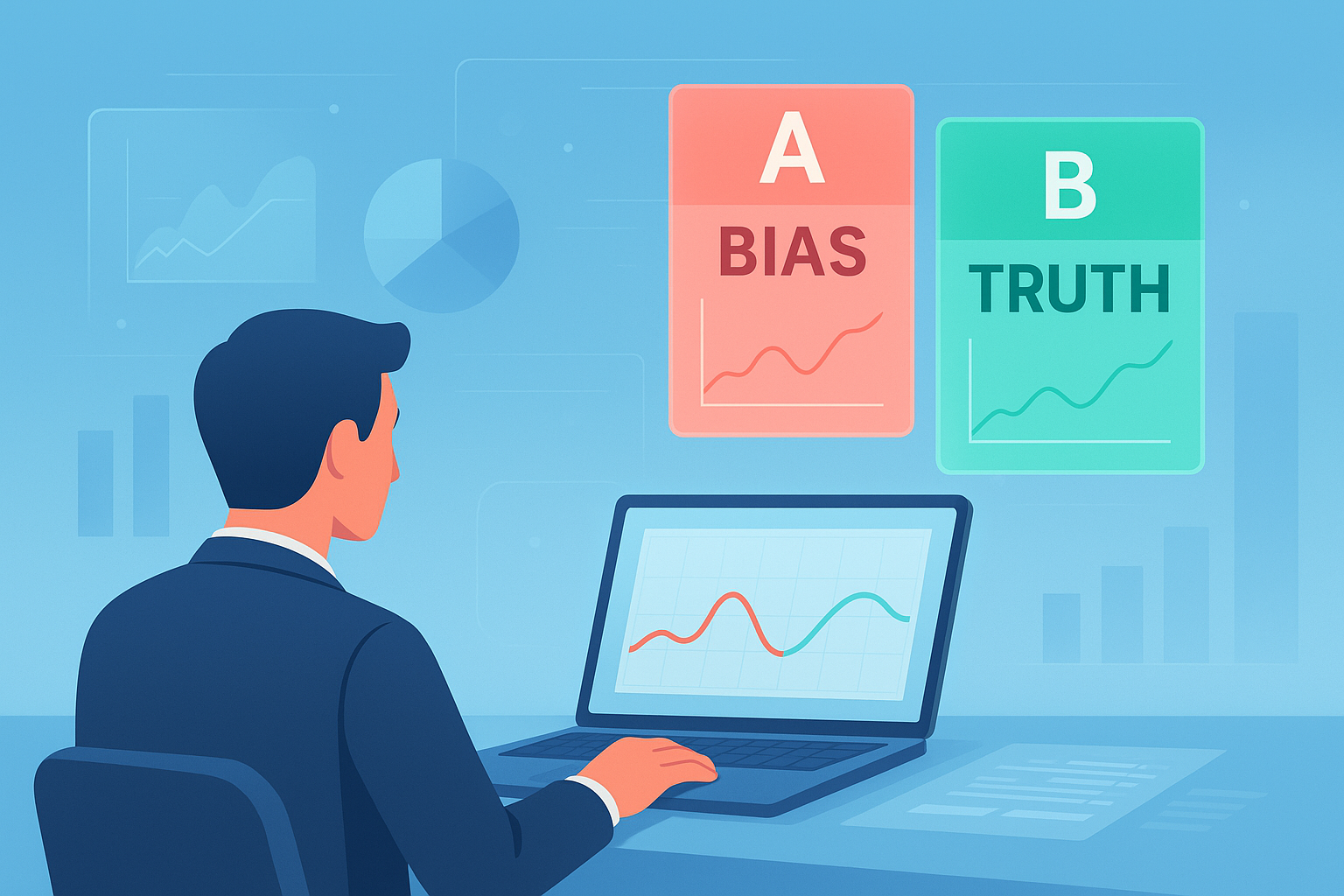
The Hidden Bias in Marketing Data (and How A/B Testing Uncovers the Truth)
Posted on October 28, 2025
Marketers today live and breathe data. From click-through rates to heatmaps and conversion funnels, every decision seems data-driven. Yet, beneath the dashboards and analytics lies a quiet problem — bias.
Bias isn’t always intentional. It sneaks in through flawed data collection, misinterpreted user behavior, and uncontrolled external factors. The result? You end up optimizing campaigns not for what works best, but for what looks best on paper.
This is where A/B testing steps in — not just as an optimization tool, but as a scientific method to uncover truth in marketing performance.
The Roots of Hidden Bias in Marketing Data
Bias in marketing data can take many forms, and understanding them is the first step toward eliminating them.
1. Selection Bias
When your data represents only a portion of your audience, it leads to distorted insights.
Example: You analyze engagement based on website visitors who already converted — but ignore those who bounced. The resulting “insight” may overstate campaign effectiveness.
2. Attribution Bias
This happens when conversions are credited to the wrong source.
For instance, your Google Ads may look like the hero, but most conversions might actually start from an organic blog post or email nurture campaign that wasn’t tracked properly.
3. Confirmation Bias
Marketers are human too. Sometimes, data is subconsciously filtered to confirm what we already believe — for example, assuming a campaign failed because of poor timing instead of weak messaging.
4. Survivorship Bias
You might analyze only the campaigns that performed well, ignoring those that didn’t. This gives an incomplete picture and inflates confidence in certain tactics.
5. Data Sampling Bias
Small or skewed samples often produce misleading results. Relying on early-stage data or a small subset of users can amplify false positives — a classic pitfall in marketing analytics.
The Role of A/B Testing: Turning Bias into Insight
A/B testing (also called split testing) helps marketers cut through bias using a controlled experimental approach. Instead of relying on assumptions or incomplete data, A/B testing directly compares two versions — Version A (control) and Version B (variant) — to measure what truly performs better.
1. Control Over Variables
By isolating one variable at a time (like a headline, CTA button, or email subject line), A/B testing ensures that changes in performance are caused by that variable alone — not by seasonality, device mix, or ad spend fluctuations.
2. Randomization Eliminates Selection Bias
A/B testing tools randomly divide users into test groups, preventing any systematic skew in who sees which version. This randomization neutralizes selection bias, ensuring fair representation of your audience.
3. Statistical Significance Reduces False Positives
A proper A/B test runs until statistical significance is achieved — meaning the observed difference isn’t due to chance. This guards against overreacting to early, misleading spikes in performance.
4. Objective Decision-Making
Because A/B testing relies on measured outcomes (conversion rate, engagement time, revenue per visitor), it reduces confirmation bias. You don’t need to “believe” one idea is better — the data proves it.
5. Continuous Learning Loop
Every test builds knowledge about your audience. Even a failed test reveals what doesn’t work, which is just as valuable for eliminating bias in future decisions.
Real-World Example: How Bias Misleads Without A/B Testing
Imagine an e-commerce brand noticing that users who come from Instagram ads buy more premium products. The team decides to double the Instagram ad budget.
But here’s the catch — those users were already loyal customers who followed the brand earlier. The higher spending wasn’t due to Instagram ads; it was due to pre-existing brand affinity.
A simple A/B test — showing ads to a randomized group and comparing their behavior with a control group — would’ve revealed the truth before the budget was wasted.
Common Mistakes That Reintroduce Bias in A/B Testing
While A/B testing is powerful, it’s not foolproof. Many marketers unknowingly reintroduce bias by:
Stopping tests too early before reaching statistical significance.
Running multiple tests simultaneously that influence each other.
Using unbalanced traffic splits (like 90/10) without considering sample size.
Ignoring seasonality or external events during test duration.
To maintain test integrity, ensure you design experiments with clear hypotheses, adequate sample size, and unbiased traffic segmentation.
Conclusion: From Guesswork to Growth
In marketing, data is only as good as its accuracy. Hidden bias distorts insights, leading to misplaced budgets and lost opportunities.
A/B testing restores the scientific discipline marketing often lacks — it replaces assumption with evidence and converts data into truth.
In a digital world full of noise, A/B testing is the compass that keeps your marketing strategy honest, focused, and grounded in real user behavior.
Key Takeaways
✅ Bias hides in even the most sophisticated analytics.
✅ A/B testing removes bias by introducing control, randomization, and statistical rigor.
✅ Each test — win or loss — brings marketers closer to understanding their audience.
✅ Without testing, data-driven decisions are just data-decorated guesses.