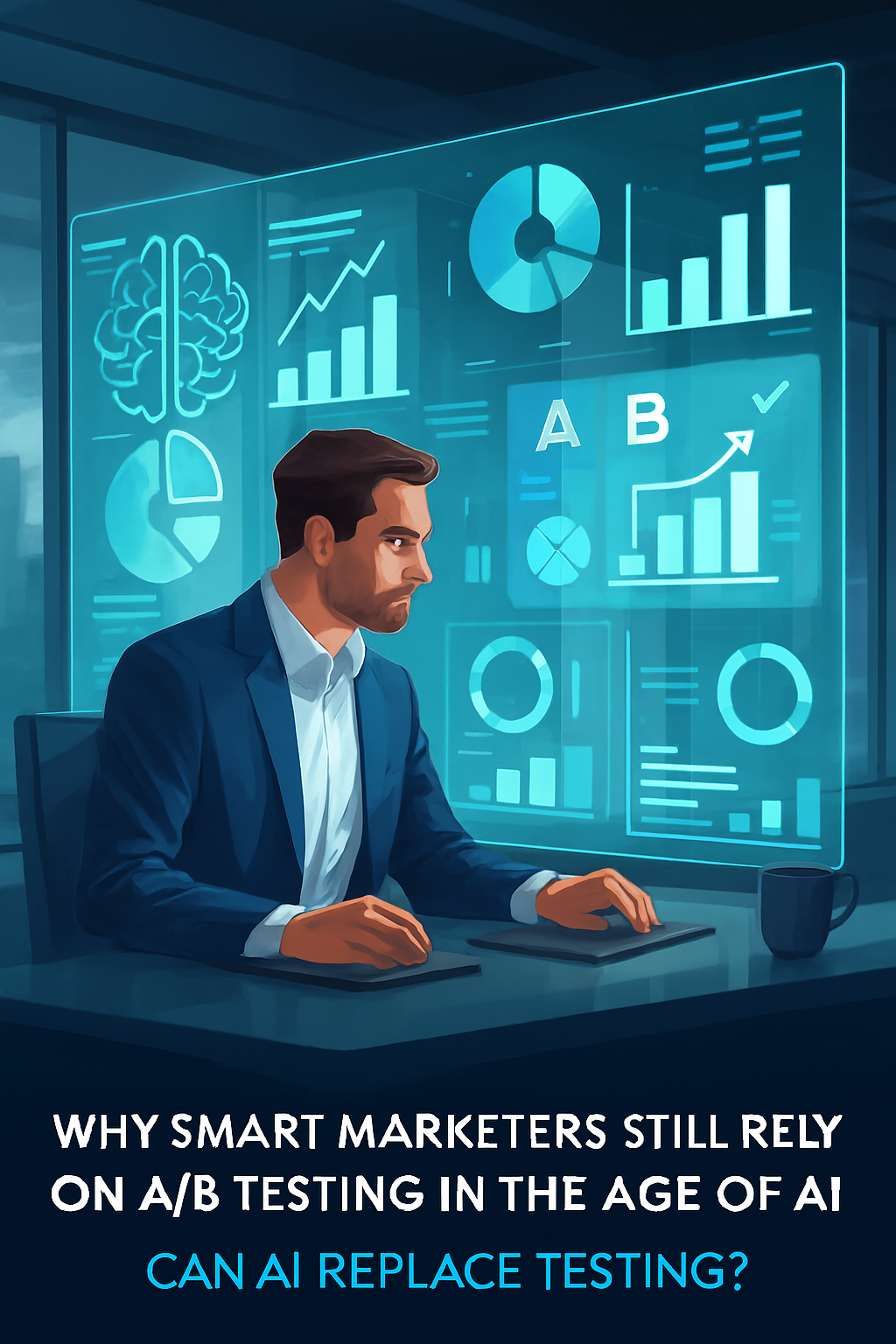
Why Smart Marketers Still Rely on A/B Testing in the Age of AI
Posted on September 26, 2025
Introduction
Artificial Intelligence (AI) has taken the marketing world by storm. From predictive analytics to personalized recommendations, AI promises to optimize campaigns faster than any human could. But even in this high-tech era, there’s one tool that continues to be the secret weapon of smart marketers: A/B testing. Why? Because no matter how advanced AI becomes, real-world audiences don’t always behave exactly as algorithms predict. A/B testing remains the bridge between machine intelligence and human psychology.
What Is A/B Testing?
A/B testing is the process of comparing two or more variations of a marketing asset — whether it’s a landing page, ad copy, email subject line, or call-to-action button — to see which one performs better with a live audience. Instead of relying on guesses or trends, marketers gather real performance data to guide their decisions.
For example, you might test:
Headline A: “Get Your Free Trial Today”
Headline B: “Start Growing With Us — Free Trial Inside”
The version with the higher conversion rate becomes the winner.
Why AI Alone Isn’t Enough
AI is powerful, but it comes with limitations. It relies on existing datasets and patterns. While it can predict what should work, it doesn’t guarantee how your specific audience will respond in the present moment. Markets shift, cultures evolve, and human behavior is never 100% predictable.
This is where A/B testing shines. Instead of blindly trusting AI’s recommendation, marketers can validate it with live audience experiments. The combination ensures that strategy is backed by both predictive intelligence and real-world evidence.
The Perfect Blend: AI + A/B Testing
Smart marketers don’t see AI and A/B testing as competitors — they use them together. Here’s how:
AI for Hypothesis Generation: AI tools can analyze past data and suggest potential winning variations.
A/B Testing for Validation: Marketers then test these variations with real users to confirm what actually works.
Continuous Improvement: AI learns from A/B test results, making its predictions sharper over time.
This cycle creates a loop of data-driven optimization where both tools make each other stronger.
Benefits of A/B Testing in the AI Era
Audience-Centric Decisions: Testing reveals what resonates with your unique audience, not just what AI predicts.
Reduced Risk: Instead of overhauling campaigns based on AI suggestions, you roll out changes gradually with testing.
Higher ROI: By continuously validating decisions, businesses avoid wasted ad spend and increase returns.
Trust and Transparency: Teams and stakeholders feel more confident in strategies supported by clear test results.
Practical Examples
Email Campaigns: AI might recommend sending emails at 9 AM, but A/B testing could reveal that your audience prefers 7 PM.
Ad Creatives: AI could predict a bold color scheme performs best, but only A/B testing shows whether it increases click-throughs.
Landing Pages: Predictive models may suggest longer copy converts better, but a split test could show shorter copy wins with your market.
Common Mistakes to Avoid
Even experienced marketers fall into traps when mixing AI and A/B testing. Watch out for:
Running too many tests at once (dilutes results)
Stopping tests too early (before statistical significance)
Ignoring context (what works today may not work next quarter)
Relying only on AI without human oversight
Future of A/B Testing in AI Marketing
The future lies in automated, AI-driven A/B testing. Imagine campaigns where AI not only suggests variations but also runs micro-experiments in real time and scales the winning option automatically. Marketers won’t disappear — but their role will shift toward strategy, creativity, and ethical oversight.
FAQs
Q: Isn’t AI powerful enough to eliminate the need for A/B testing?
A: No. AI predicts, but A/B testing validates. They work best together, not separately.
Q: How long should I run an A/B test?
A: At least until you achieve statistical significance — often 1–2 weeks depending on traffic volume.
Q: Can small businesses benefit from A/B testing?
A: Absolutely. Even minor improvements in conversion can lead to major revenue gains over time.
Q: What tools combine AI and A/B testing?
A: Platforms like VWO, Optimizely, and Adobe Target integrate AI insights with testing.
Q: How often should I test?
A: Continuously. Audiences evolve, competitors innovate, and market conditions change. Testing ensures you always stay ahead.
Conclusion
AI is reshaping marketing, but it hasn’t replaced the power of real-world validation. Smart marketers continue to rely on A/B testing to refine AI-driven insights, protect ROI, and build campaigns that truly connect with audiences. In the age of AI, A/B testing isn’t old-fashioned — it’s the ultimate secret weapon.